
The 2026 Parent's Guide to Choosing an Online English School
A note on transparency: This guide is written and published by Meridian English. We have done our best to represent each model fairly, including options we do not offer. We encourage you to research all providers independently and speak to current families before making a decision.
Why Choosing the Right Online English School Matters
Online English learning for children has grown rapidly across Europe. What began as a convenience during the pandemic has become a permanent part of many families’ education plans, and the market has expanded considerably.
Parents now have many platform options, different lesson formats, price variations, and competing claims about teacher qualifications and accreditation. This guide is designed to cut through the noise.
It does not declare any one provider ‘best.’ It explains the main models clearly, sets out what to look for in 2026, and helps you match the right approach to your child’s personality and goals.
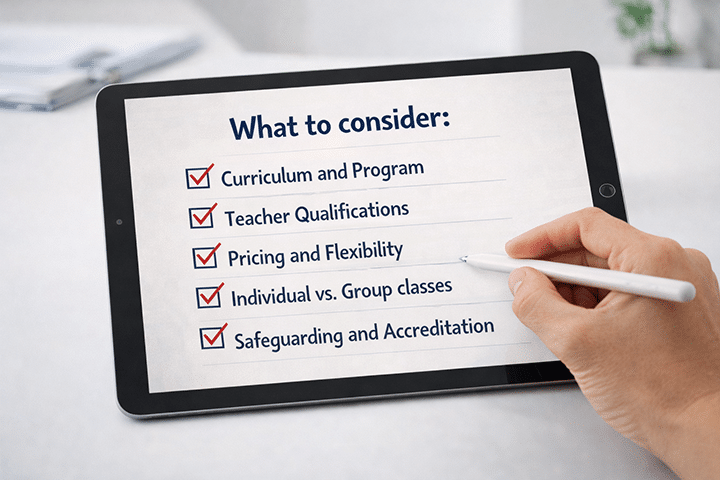
1. The Four Main Models of Online English Learning
Not all online English providers operate the same way. Understanding the structure behind the service helps you make better comparisons.
Model 1 — British Council Accredited (Online) School
Example: Meridian English
This model operates like a traditional school, but online. British Council accreditation holds the school accountable across five areas: Management, Resources and Environment, Teaching and Learning, Welfare and Student Services, and Safeguarding Under 18s. This means teaching quality, curriculum standards, safeguarding procedures, and governance are all subject to external review — not just self-reported.
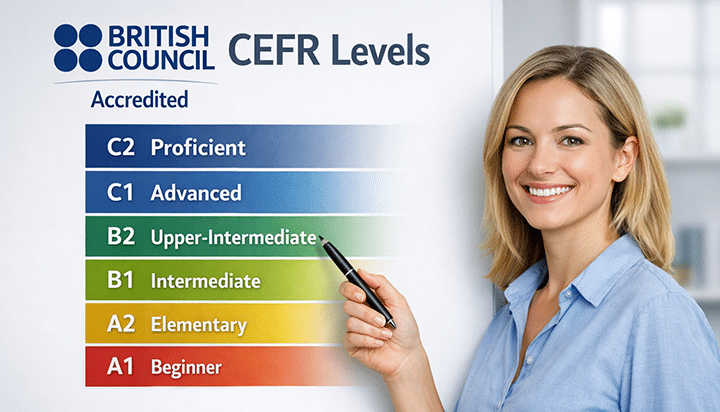
Lessons take place in small live groups, following a structured curriculum aligned to CEFR levels (A1–C2). Teachers are centrally recruited, typically hold CELTA or Trinity CertTESOL qualifications, and the school operates a formal safeguarding framework and data protection policy.
Accreditation requires evidence of a rigorous curriculum, resulting in a defined start and end point for each level, with academic reporting and progression tracking. Children are not learning in isolation — they interact with peers, which is central to how language develops.
This model suits families who prioritise long-term progress, consistent teacher quality, and structured academic accountability.
Model 2 — Gamified 1:1 Platform
Example: Novakid
This model combines one-to-one lessons with an app-based interface, animation-driven engagement, and visual rewards. It is designed to hold the attention of younger learners and make sessions feel fun and low-pressure. Scheduling is highly flexible, typically via a subscription.
The main trade-off is that communication is almost entirely teacher-to-student. There is no peer interaction, and teacher qualifications vary depending on the individual tutor. Progress tracking is platform-based rather than formally reported.
This model suits younger beginners, children who prefer individual attention, and families who value maximum scheduling flexibility.
Model 3 — Open Tutor Marketplace
Example: Preply
Marketplace platforms connect families directly with independent tutors. Parents browse profiles, compare prices, and book on a pay-per-lesson basis. There is a large pool of tutors available across a wide price range.
The key variable is consistency: there is no central curriculum, and the quality of progress tracking depends entirely on the individual tutor you select. Parents need to assess teacher suitability themselves.
This model suits older children needing flexible or short-term support, and families with tighter budgets who are willing to do the research to find the right tutor.
Model 4 — Traditional Offline Language School
Physical language schools remain a well-established option across Europe. Lessons take place in a real classroom, with in-person peer interaction and a tangible learning environment.
The trade-offs are fixed timetables, travel time, and often larger class sizes. For families who prefer face-to-face learning and a local presence, this model has genuine value.

2. Group vs 1:1 — Which Builds Real Communication Skills?
One of the most important decisions parents face is the lesson format. Both approaches have genuine strengths.
1:1 lessons offer targeted attention, immediate correction, and a low-pressure environment that can help shy learners build confidence. The pace adjusts to the child rather than the group.
Small-group learning builds something different: the ability to actually communicate. Children practise turn-taking, listening, responding to peers, and managing interaction — skills that matter far beyond the classroom. Studies in second language acquisition consistently point to interaction with peers, not just teachers, as a key driver of fluency development.
Language is social by nature. Children do not use English only with a teacher — they need it in classrooms, with peers, and in real-world contexts. Small-group environments replicate this more authentically.
Many families find that a blended approach works well: starting with 1:1 for confidence, then transitioning to group lessons for communication development. Some providers offer both, though most are stronger in one than the other.

3. Teacher Qualifications — What Should Parents Look For?
Teacher quality is one of the most significant variables in online English provision, and it is worth asking providers directly about their recruitment and oversight processes.
Qualifications to look for include CELTA (Certificate in English Language Teaching to Adults), Trinity CertTESOL, a relevant degree, and demonstrated experience teaching children — all of which are required for a British Council accredited school. These are not guarantees of quality, but they are meaningful signals. What separates good schools from great ones is not just who they hire, but how actively they manage and develop their teachers once in post.
Beyond qualifications, consider:
- How are teachers recruited and vetted?
- Are DBS checks or equivalent background checks conducted?
- Is there ongoing professional development?
- What happens if a teacher is absent?
- Who is responsible for the quality of teaching — a central team, or the individual tutor?
On marketplace platforms, all of this varies by individual profile. On school-based models, teacher recruitment is centrally managed — which means more consistency, but also means you are trusting the institution’s hiring standards. Both approaches have merit; the question is where you want oversight to sit.
4. Curriculum and Progression — Is There a Clear Path?
A structured curriculum means your child is working towards something measurable, not just completing lessons. CEFR alignment (Common European Framework of Reference for Languages, A1 through C2) is the most widely recognised framework for this.
Providers with a structured approach will typically offer formal progress reports, defined learning objectives, regular assessment — both low-stakes checks during lessons and more formal end-of-level reviews — and a clear answer to the question: what level will my child reach after one year of n hours a week?
Providers without a curriculum can still deliver valuable lessons — particularly for conversational practice or targeted exam support — but parents should be realistic that measurable, cumulative progression is harder to achieve without structure.
Key questions to ask any provider:
- How is progress measured and reported?
- Is the curriculum aligned to CEFR or another recognised framework?
- Is there continuity of teacher across lessons?
- What happens if my child plateaus?

5. Pricing — Understanding What You Are Comparing
Online English pricing can seem confusing because different providers use different models: monthly subscriptions, term-based tuition, pay-per-lesson bundles, or discounted packages. A lower headline price does not always mean lower total cost over time.
When comparing providers, look beyond the advertised price and consider:
- Cost per hour (divide total cost by total lesson time)
- Lesson length — a 30-minute and a 45-minute lesson at the same price are not equivalent
- Group size — 1:1, pairs, or groups of 4–6 deliver different learning experiences
- What is included — materials, reports, parental communications
- Cancellation and refund policy
Higher prices may reflect smaller class sizes, stronger teacher qualifications, accreditation overheads, or more robust safeguarding infrastructure. Lower prices may reflect a marketplace model where those costs sit with the individual tutor. Which represents better value depends entirely on what matters most to your family.

6. Safeguarding and Accreditation — Why It Matters
For UK and European families, safeguarding and data protection are increasingly important selection criteria — particularly for younger children in live online environments.
Before enrolling a child with any provider, parents may wish to check:
- Does the provider have a published safeguarding policy?
- Are sessions recorded or monitored?
- Is the company GDPR compliant? (Particularly relevant if the provider is based outside the EU or UK)
- Is the organisation accredited by a recognised body?
Accreditation from bodies such as British Council or EAQUALS involves external review of teaching quality, safeguarding procedures, curriculum standards, and governance. It is not a guarantee of quality, but it is a meaningful signal of institutional accountability.
Providers operating as platforms — connecting parents with independent tutors — will typically have platform-level policies rather than school-level safeguarding frameworks. This is not necessarily a problem, but it is worth understanding the difference.
7. Quick Comparison Summary
The table below summarises the four main models across the key criteria discussed in this guide. Use it as a starting point, not a final verdict — every child and family is different.
| Comparison Factor | Meridian English (Online School) | Novakid (Learning Platform) | Preply (Tutor Marketplace) | Traditional English School |
|---|---|---|---|---|
| Learning Model | Accredited online English school | Gamified online learning platform | Open tutor marketplace | Physical classroom school |
| Lesson Format | Small-group live classes | 1:1 live lessons | 1:1 private lessons | Group classroom lessons |
| Curriculum Structure | Structured programme aligned to CEFR levels | Platform-designed learning path | Depends on individual tutor | Structured school curriculum (varies) |
| Teacher Qualifications | Centrally vetted teachers, typically qualified UK educators | Varies by teacher | Varies by tutor profile | Usually qualified language teachers |
| Accreditation & Quality Assurance | Accredited online school with central quality standards | Platform provider (not a school) | Marketplace platform (not a school) | Often locally accredited school |
| Peer Interaction | Yes – small group learning | No – individual lessons | No – individual lessons | Yes – classroom learning |
| Progress Tracking | Formal progress reports and level progression | Platform progress dashboard | Depends on tutor | Term reports and teacher feedback |
| Safeguarding Framework | School-led safeguarding policies | Platform policies | Platform policies | School safeguarding policies |
| Pricing Model | Subscription-based tuition | Subscription model | Pay-per-lesson pricing | Term-based school fees |
| Scheduling | Fixed timetable with group options | Flexible booking | Flexible booking | Fixed school timetable |
| Best For | Structured progression and communication skills | Gamified individual learning | Flexible short-term tutoring | Students who prefer in-person learning |
8. Which Model Is Right for Your Child?
The honest answer is that there is no universal ‘best.’ The right model depends on your child’s personality, your family’s priorities, and what you are trying to achieve.
The shy beginner
May benefit from 1:1 lessons first to build confidence in a low-pressure environment, before transitioning to small-group learning for communication development.
The social learner
Often thrives in small groups where interaction is active, peers model language, and communication is the point — not just a by-product.
The academic high achiever
Likely needs structured CEFR-aligned progression with qualified teachers, formal reporting, and a clear pathway towards exam readiness or advanced fluency.
The family that needs flexibility
May prioritise subscription-based or pay-per-lesson models with flexible scheduling, and be willing to manage more of the curriculum consistency themselves.
The budget-conscious parent
Marketplace options offer lower hourly rates, but require more parental research to identify strong individual tutors and manage continuity of progress.
9. Frequently Asked Questions
The honest answer is that there is no universal ‘best.’ The right model depends on your child’s personality, your family’s priorities, and what you are trying to achieve.
What is the best online English school for children in Europe?
That depends on your priorities. If you value structured progression, peer interaction, and qualified teachers, an accredited school model is likely the best fit. If flexibility and individual attention matter most, a 1:1 platform may suit better. If budget is the primary driver, a marketplace platform gives you the most options.
Are online English classes effective for children?
Yes — particularly when they are interactive, structured, and led by qualified teachers. Engagement, consistency, and communication practice are the three factors most consistently associated with good outcomes.
Is group learning better than 1:1?
They develop different skills. Group learning builds real communication — turn-taking, listening, peer interaction. 1:1 builds individual confidence and allows for targeted correction. Many families use both at different stages.
What qualifications should an online English teacher have?
Look for CELTA, Trinity CertTESOL, or a relevant degree alongside demonstrated experience with children. Ask the provider how they recruit teachers and what ongoing training or oversight they provide.
How much do online English lessons cost in the UK and Europe?
Costs vary widely by format, group size, and teacher qualifications. The most useful comparison is cost per hour — calculated by dividing total cost by total lesson time — rather than the headline monthly or weekly price.
How do I know if an online English school is accredited?
Ask the provider directly and verify independently. Accreditation bodies such as British Council and EAQUALS publish lists of accredited providers. Not all strong providers are formally accredited, but accreditation does indicate external review has taken place.
Choosing With Confidence
Online English education in 2026 offers more choice than it ever has. The key is not to find the most impressive-sounding provider, but to find the right model for your child.
Rather than asking which company is ‘best,’ it helps to ask:
- Does this model suit my child's personality and learning style?
- Is there a clear, measurable progression pathway?
- Are teachers qualified, vetted, and consistently available?
- Is communication practice genuinely built into lessons, or is it teacher-to-student only?
- Is the pricing structure transparent and easy to compare?
- What safeguarding and data protection policies are in place?
Understanding the model behind the service brings clarity. With the right fit, online English learning can be flexible, effective, and genuinely transformative for children across Europe.