
Why British-Qualified Teachers Matter in Online English Education for Children (2026 Parent Guide)
A Practical Parent Guide (Europe Edition – 2026)
When choosing online English classes for children, many platforms advertise “native speakers.” But experienced parents are increasingly asking a more important question:
Are the teachers professionally trained and British-qualified?
In 2026, as AI-generated content and marketplace tutoring platforms continue to grow, teacher quality has become the real differentiator. This guide explains why British-qualified teachers deliver stronger outcomes — particularly for children aged 5–12.

What Does “British-Qualified” Actually Mean?
A British-qualified English teacher holds formal professional training such as:
- Cambridge Assessment English – CELTA or DELTA
- Trinity College London – CertTESOL or DipTESOL
- UK Qualified Teacher Status (QTS)
These qualifications require observed teaching practice, grounding in child language development theory, assessed lesson planning, and structured feedback from senior trainers. This is rigorous, assessed professional training — not simply fluency in English.
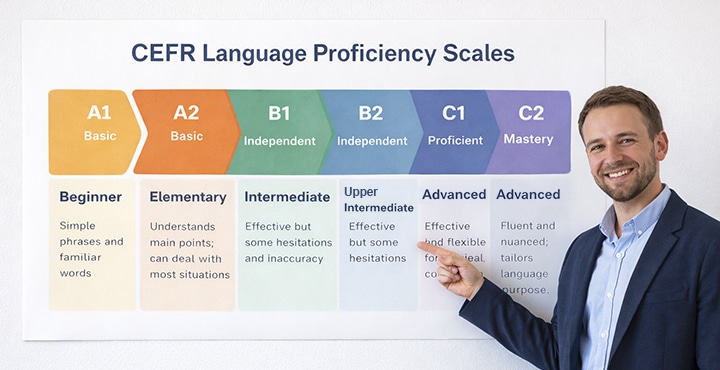
1. Structured Progression Using the CEFR
British-trained teachers align lessons to the CEFR (Common European Framework of Reference), the internationally recognised language framework developed by the Council of Europe.
This ensures:
- Clear level progression from Pre-A1 through to B1 and beyond
- Balanced development across reading, writing, speaking, and listening
- Transparent assessment benchmarks that parents can understand
- International portability for globally mobile families
For families based in the UK, Europe, the Middle East, or Asia, this kind of structured continuity matters enormously.

2. Safeguarding and Child Protection Standards
The UK maintains some of the world’s most rigorous safeguarding frameworks for educators working with children. British-qualified teachers are trained in child protection protocols, online classroom safety, professional boundaries, and GDPR awareness.
Teachers employed by a British school are also required to hold an Enhanced DBS check — a thorough background check covering criminal convictions and other relevant information.
In live online lessons, safeguarding is not optional. It is foundational. Parents should expect formal, documented safeguarding training from any school their child attends — not informal reassurances.
3. Evidence-Based Teaching Methods
British teacher training is grounded in proven, research-backed approaches, including:
- Synthetic phonics for early reading development
- Guided reading progression
- Structured grammar teaching
- Retrieval practice and spaced repetition
- Corrective feedback techniques
Rather than open-ended “free talk” sessions, children experience lessons with clear learning objectives, targeted language correction, measurable progress tracking, and guidance aligned to lesson goals.
The result is genuine literacy development — not just spoken confidence.

4. Academic Oversight and Quality Assurance
In professionally managed schools, British-qualified teachers work within structured systems that include schemes of work, curriculum planning cycles, peer observation, ongoing CPD (Continuing Professional Development), and Director of Studies oversight.
This creates the consistency and accountability that parents should expect — especially in small-group online environments where individual progress must be carefully tracked.
Many marketplace platforms lack this academic infrastructure entirely.
5. Accent Clarity and Global Recognition
British English remains the reference point for Cambridge English examinations, which are widely recognised across Europe and Asia, and aligns closely with the curricula of international schools worldwide.
For families considering UK independent schools, European international schools, or long-term academic mobility, phonics accuracy and pronunciation clarity are genuine strategic advantages.
British-Qualified Teachers vs “Native Speakers”: A Quick Comparison
| Criteria | British-Qualified Teacher | Unqualified Native Speaker |
|---|---|---|
| Formal training | ✅ CELTA / CertTESOL / QTS | Often none |
| Child pedagogy | ✅ Assessed and supervised | Variable |
| Safeguarding | ✅ Mandatory UK standards | Platform-dependent |
| Curriculum alignment | ✅ CEFR and UK frameworks | Often conversational only |
| Academic oversight | ✅ Structured and documented | Often freelance |
6. Frequently Asked Questions (2026)
Are British-qualified teachers better for children learning English?
What is CELTA and why does it matter?
Do online English teachers need safeguarding training?
- For any teacher working with children under 18, safeguarding training and background checks — such as the UK Enhanced DBS — are essential, not optional. Parents should ask schools directly about their safeguarding policies.
Do parents need to sit in lessons?
For under 8s, sit nearby initially.
For older children, encourage independence.
What is the CEFR and why is it important for my child?

What Parents Should Take Away in 2026
As AI tutoring, recorded lessons, and gig-economy platforms proliferate, teacher qualification has become the single most reliable indicator of quality.
For children aged 5–12 — when pronunciation, phonics, and literacy foundations are being formed — British-qualified teachers offer structured progression, meaningful safeguarding, academic accountability, and internationally recognised standards.
When comparing online English schools, qualifications are not a minor detail. They are the foundation everything else is built on.